Requirement Document
Galaxy Sleuth
Course:
CS 425
Date: September 25, 2001
Team:
Andromeda
Team
Lead: Dorothy Cheung
Contact:
pik@unr.nevada.edu
Team
Members:
Jason Dodd
William Nelson
Andrew Rodgers
Will Woolsey
Beifang Yi
List
of sections
- Requirements questions
- Supported activities
- HCI
- Solved problems list
- Information sources list
- Checks and Balances
- Security and fault-tolerance requirements
- Information Capacity and Growth
- Project time frame
- Prioritization of
requirements
- Ethical concerns
Requirements
questions
- Is
the player only allowed to use the planet that he/she is on to form the
hypothesis? What if the player lands on one of the four planets having a
wormhole connection wishes to land directly to another planet, which
planet should the hypothesis based on?
- Can
the player make a hypothesis as he/she enters the planet? Or does he/she
wait for the next turn?
- Can
more than one suspect be on the same planet at the same time?
- Does a planet represent a “square”? Can
the player move in and out of a planet during the same turn?
- What
would happen to the evidences if a player bails out during the game?
Shouldn’t there be a time limit for each turn?
- Is
there a limit on the number of times a player can visit the same planet?
- The player has landed on the planet without a
wormhole in a previous turn. Now he/she would like to move out of
the planet, but the other player is blocking the entry point. What
happens? Does the player continue to make another hypothesis or does the
player loses a turn?
Supported activities
Supports a client/server structure, in which the client supports a player’s perspective of the game and the server coordinates and manages the game.
The
server:
- Supports the game.
o
Communicates
with clients.
- Selects a random murder
scenario consisting of a perpetrator, a murder weapon, and a planet where
the murder takes place. Selection
is made when the first player initiates a game.
- Distributes remaining
evidence about the murder to each player. The evidence consists of a
perpetrator excluding the actual perpetrator, a murder weapon excluding
the actual murder weapon, and a planet excluding the actual planet in
which the murder takes place.
o
Murderers
and their colored token:
§
Tina
Time-traveler (red token), Same space-voyager (blue token), Moan moon walker
(yellow token), George galaxy-wanderer (green token), Uhura universalist
(purple token), Steve star - gazer (white token)
o
Weapons:
§
Phaser,
Hyper rope, Laser sword, Biological agent, Flame thrower, Radio-active
o
Planets:
- Cathitar, Earth,
Evilon, Linuda, Neudel, Pheadrun,
Ping, Psu, Verlute
- The order of
distribution is the order of player sign-on.
- Monitors the game.
o
Unoccupied
or occupied planets, and who occupies it.
o
Selected
tokens in the game.
- Communicates a murder
hypothesis posted from a player to the other players in the order of the
starting sequence.
- A hypothesis consists
of a murderer, a planet, and a weapon.
- Informs all players
that the hypothesis is or is not refuted, but does not reveal any
information on which piece of the hypothesis is refuted except to the
player who posted the hypothesis.
- Communicates a murder
hypothesis announced to all players.
- Informs all players
about the correctness of the hypothesis made.
- Begins a game when
there are between three to six players as specified by the first player
who initiates the game.
- Places each token at
one of the corner entrances on the game board.
- Keeps a record for
every player.
o Location
o
Status: a winner, a loser or neither
- Ends a game if a
correct murder hypothesis is announced or the number of players is reduced
to two or less.
- Prevents more players
from joining the game if there are six players already.
- Keeps track of a
player’s turn according to the rules of the game.
(The rules are further
defined in the Checks and Balances section in this document.)
- Each turn consists of
a spin on the spinner followed by the movement of the player’s token.
- Once a player enters a
planet his/her movement on the board is completed for that turn. Passage
through a wormhole is considered to be one turn.
- Allows the player to
make a hypothesis when he/she enters the atmosphere during the same turn.
- Allows the first player
to initiate a game to decide on the game parameters.
- Time limit or Wait for
a specified number of players between three and six inclusive.
- Reveals the evidence
processed by the player who loses the game to all remaining players.
- Monitors the time limit
on each turn.
- Each player will have
a small amount of time to move and then a longer time for a hypothesis.
Otherwise they forfeit that turn.
- Controls the evidence
of the player who bails out during the game.
- Deals with
communication problems
- Delays a hypothesis or
a disproof submission.
- Communicates with
client through a special command/message.
The
client:
- Associates with a home
page.
- Supports the game.
- Interfaces: a board
game, a window that keeps track of evidence gathered, and
other
screens.
o
Communicates
with the server.
- Depending on the
response from the server, it allows a player to start a game if none has
initiated; otherwise, it allows a player to join the game if there are
less than six players.
- Displays a special
window that helps each player to keep track of the evidence shown and the
hypothesis outcomes.
- Updates the situation
of the game.
- Who is taking the
turn, where is the player moving to
- Includes a help option
that informs the player about the game if he/she prefers.
- Allows a player to post
a hypothesis on who the murderer is, where does the murder takes place,
and what weapon is used.
- Allows a player to post
a hypothesis and/or to announce a hypothesis during a turn.
- Allows the player who
loses the game to continue to refute the hypothesis posted by other
players, but does not allow him/her to continue to make any moves on the
board or to pose/announce any hypothesis.
- Sends a request to the
server to begin or end a game.
- Deals with
communication problems
- Informs the players.
- Communicates with
server through a special command/message.
HCI
An Illustration
of the game
board
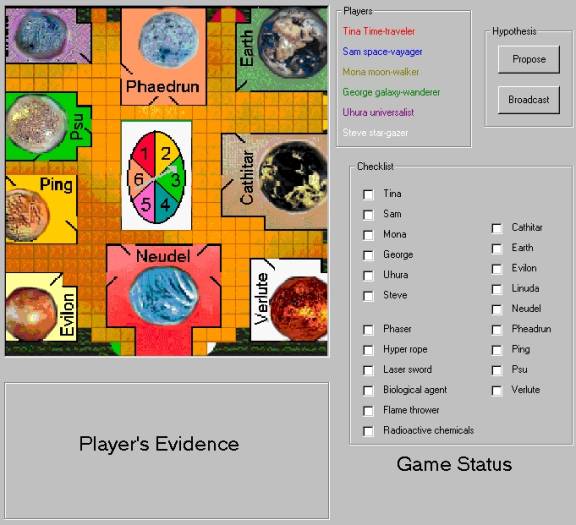
Solved
problems list
Needed
a hobby.
Information sources list
The
only information is game play related, which resides on the server. There should not be any performance
bottleneck, because only one user takes a turn or refutes evidence at a time.
Checks and Balances
Prohibits an erroneous respond to a murder hypothesis. In other words, it should prevent a player from refuting a hypothesis if he/she does not have any evidence for. It also should prevent a player from refusing to refute a hypothesis that he/she can refute. However, if the player has more than one piece of evidence that can be used to refute the hypothesis, he/she can reveal one of them to the inquiring player.
Performs
integrity tests according to the rules of the game specified in the project
overview.
- A player must enter the
planet’s atmosphere at one of the predefined entry points, and depending
on the planet, it might have between one and three entry points.
- A player does not have
to enter a planet in an exact number of moves.
- A player cannot revisit
the same planet within a single turn.
- A player is allowed to
announce a hypothesis on any planet that he/she is on.
- A player is not allowed
to post a hypothesis on a different planet than the one he/she is
currently on.
- If the player lands on
an entry point, he/she needs to take another turn to get into the planet.
- It takes a turn for a
player to move from one planet into another planet through a wormhole.
- A player is allowed to
pose a hypothesis as soon as he/she enters a planet’s atmosphere.
- A player cannot move
into a cell occupied by the token of another player. However, he/she is
allowed to enter an occupied planet.
- A player must not move
to the same cell twice during a turn.
- A player loses his/her
turn if the entry points of the planet that he/she is on are blocked.
- There is no restriction
on the number of times a player can visit the same planet.
Security
and fault-tolerance requirements
1.
There is no logon so there needs not to be encryption or things of that nature.
You cannot enter a game after it has begun as it is locked.
2.
Simple error checking to ensure all rules are abided by is implemented.
Therefore, no one can move out of turn nor make illegal moves or hypotheses.
3.
If the game goes down, no entertainment until it is up again.
Information
Capacity and Growth
It
would be nice to have the ability to play more than one game at a time. That way, users do not have to wait for a
game to end before they can join.
However, we are not going to support this feature. So there will only be three to six users on
at a time.
Project
time frame
This project is to be completed by the end of the Fall
2001 school semester.
Prioritization of
requirements
Must
have:
Start
/ join a game
Spinner
selects a number between one thru six, may not be animated.
Player’s
piece moves on the board
Player’s
piece enters a planet
Game
play changes to next player.
Player
can use a wormhole at the beginning of the turn
Posing
a hypothesis
Announcing
a hypothesis
Refuting
evidence
Let
the player know if the posed hypothesis was refuted and by what
Let
the other players know that the hypothesis was refuted
Let
every player know if the hypothesis was not refuted
Winning
the game due to a correct announcement.
Sitting
out of a game due to an incorrect announcement.
Evidence
list interface so user can check off evidence.
Simple
refute system, so game can refute evidence if a player leaves.
Nice
to have:
AI
Animated
spinner.
Animation
on a player landing on a planet.
Game
sounds, such as effects and taunts between the players.
Ability
to have more than one game in existence at one time.
A
chat window for the players to communicate (however this could promote
cheating).
Ethical concerns:
- The game would
basically remember nothing from game to game about the players who played.
There is no database of players or compilation of attributes that could be
accessible. There is no logon it is simply a quick connect to the game
where they choose a handle for themselves and no other info is required.
When six players join, or time runs out, the game begins.
- There would be no
method to cheat in the game, such as viewing others cards.
- This game in no way
endorses nor "makes light" the actions of criminals,
particularly those convicted of murder.