4.- Head Pose Estimation
The vision module includes three processing steps: (a) marker extraction, (b) pose estimation, and (c) uncertainty estimation. First, the markers are extracted in each image. Then, the head pose is estimated by reconstructing the location of the markers in 3D through triangulation. Finally, uncertainty associated with the estimated pose is calculated.
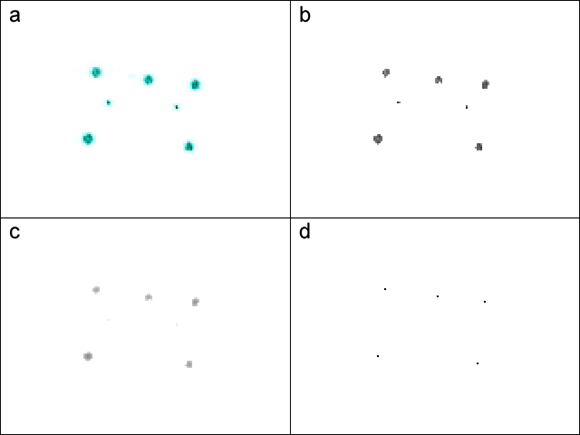
Figure 4. Negative of the images from each stage of the process starting with: a) input image; b) thresholded with a value of 100; c) smoothed with a 9-pixel Gaussian filter; and d) final image showing the centers.
4.1 Marker Extraction
The combination of IR illumination and IR reflective markers allows for fast and robust feature extraction. In the input images (see Figure 3(a)) the background is already suppressed due to the use of the filter that blocks visible light, allowing the detection and extraction of markers through a simple thresholding operation as shown in Figure 3(b). The thresholded image is then processed using a Gaussian filter to eliminate noise (see Figure 3(c)).
For each marker on the image, we estimate its center with sub-pixel accuracy (see Figure 3(d)). It should be noted that, it is still possible to get some extra blobs during segmentation due to light reflections on the eye-glasses; however, the special arrangement of markers (see Figure 4) can help us to eliminate them (e.g., by requiring that the upper 3 markers lie roughly on a line). This special marker configuration also allowed us to identify uniquely each marker on a single image (e.g. establish correspondences between the left and right images).
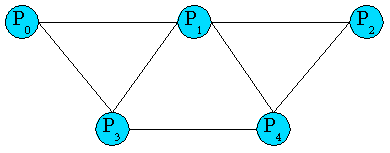
Figure 5. Marker arrangement on the glasses.
4.2 Pose Estimation
Once the markers have been extracted in each image, the center of each marker can be used to calculate its 3D location using triangulation. In our approach, the location of the head is estimated by the location of the middle marker P1 while its orientation is estimated by averaging the normal vectors corresponding to the three triangles shown Figure 4. We have validated the accuracy of our head pose estimate algorithm using a magnetic tracker with an accuracy of 1.8mm in the position and 0.5° in the orientation.
4.3 Uncertainty Estimation
It is possible to associate an uncertainty measure to both the position and orientation estimates of the head; however, we have observed that the uncertainty in orientation has a much higher effect on the LOD mainly due to the amplification of the error in the calculation of the point of interest on the screen (see Section 5). Therefore, we are only considered estimating orientation uncertainty.
Uncertainty calculation in stereo vision is a well studied topic. In general, it is possible to propagate calibration and feature localization errors to the estimates of 3D position and local orientations [15]. However, estimating orientation uncertainty analytically in our system was rather difficult; therefore, we implemented a random sampling approach.
Specifically, in matching two markers, we assume that the correspondences between pixels belonging to each marker are unknown. Using the epipolar constraint and the distance of the pixels from the center of the marker, we generate a cloud of 3D points for each marker. Then, each cloud is randomly sampled and all possible combinations of the samples are used to generate orientation estimates by computing the covariance matrix of the samples.