6.- Subject Tests
The objective of our tests was to quantify the improvement obtained by incorporating uncertainty correction on a perceptually oriented display system. The test application displays a terrain section or height map (see Figure 5), on which PLOD optimizations are applied. The user is shown three test cases (i.e. different views of the terrain), each containing three scenarios.
The first scenario presents the user with common optimizations found in the literature; namely velocity, contrast and eccentricity. The second scenario uses a constant uncertainty correction to modify the way eccentricity behaves. The constant uncertainty matrix is chosen to contain the maximum uncertainty values obtained using our algorithm on a large number of experiments. The third scenario uses uncertainty corrections like before; however, the covariance matrix is continuously updated through the sampling algorithm presented in Section 4.2.
In each case, the user was asked to judge the amount of changes perceived all over the screen while browsing the map by moving his/her head. The judgment of the user is constrained to be high, medium or low/no changes. This judgment is obviously very subjective but it helps establishing a baseline for comparing the results of different types of tests. We are only interested in the relative change rather than the absolute values of the responses.
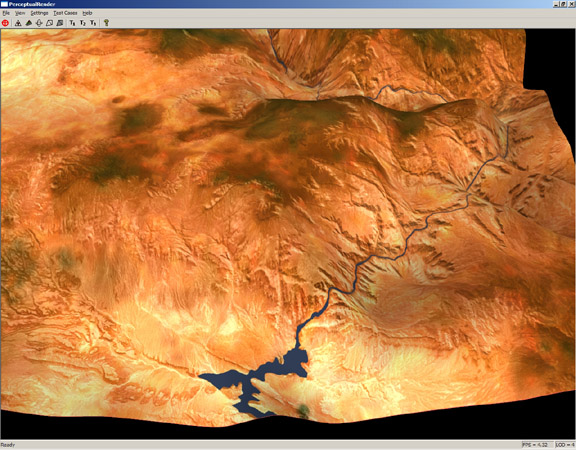
Figure 6. Terrain view for test case 2.
Our experiments were performed using 19 test subjects. Comparisons between different scenarios were performed, tabulating the increase and decrease rate of one test scenario versus the other. Our results are shown in Tables 1-4. In all tables, changes in user‘s satisfaction across the three scenarios are listed in the first column. In all cases, a change in user‘s satisfaction could be an increase, no change or a decrease. Table 1 shows the average over all cases, while Tables 2, 3 and 4 show the results for test cases 1, 2 and 3 respectively.
Table 1. Satisfaction comparison between test scenarios across all test cases
| All cases | Increase | No Change | Decrease | Total |
| Fixed vs. None | 63.16% | 29.82% | 7.02% | 100% |
| Variable vs. None | 26.32% | 54.39% | 19.30% | 100% |
| Variable vs. Fixed | 8.77% | 33.33% | 57.89% | 100% |
Table 2. Satisfaction comparison between test scenarios for test case 1
| Case 1 | Increase | No Change | Decrease | Total |
| Fixed vs. None | 52.63% | 47.37% | 0.00% | 100% |
| Variable vs. None | 21.05% | 52.63% | 26.32% | 100% |
| Variable vs. Fixed | 10.53% | 21.05% | 68.48% | 100% |
Table 3. Satisfaction comparison between test scenarios for test case 2
| Case 2 | Increase | No Change | Decrease | Total |
| Fixed vs. None | 63.16% | 31.58% | 5.26% | 100% |
| Variable vs. None | 21.05% | 63.16% | 15.79% | 100% |
| Variable vs. Fixed | 0.00% | 42.11% | 57.89% | 100% |
Table 4. Satisfaction comparison between test scenarios for test case 3
| Case 3 | Increase | No Change | Decrease | Total |
| Fixed vs. None | 73.68% | 10.53% | 15.79% | 100% |
| Variable vs. None | 36.84% | 47.37% | 15.79% | 100% |
| Variable vs. Fixed | 15.79% | 36.84% | 47.37% | 100% |
From Table 1, we can see that the use of fixed uncertainty greatly improves performance. In the case of fixed uncertainty, only 7% of the time people perceived worse performance compared to not having uncertainty optimizations enabled. The results for dynamic uncertainty are not as good as those for fixed uncertainty. About 55% of the time people did not notice any differences between using variable uncertainty and not using it. The direct comparison between dynamic and static uncertainty shows that dynamic uncertainty performance is clearly perceived as worse 57% of the time. Similar results can be observed for all test cases as shown in Tables 2-4.
Further analysis of our system‘s performance revealed that the main reason for the underperformance of the variable uncertainty approach was the jitter in the uncertainty covariance matrix. In particular, the calculation of the covariance matrix was not very stable and its values oscillated. These oscillations made the triangles that lie on the outer edges of the high resolution region to change levels back and forth from one level to the next. Since the human eye has an increased sensitivity to movement on the periphery compared to the center, this effect made the users more aware of changes in the periphery. The main reason for the oscillations was probably our sampling strategy. For the sake of high processing speed, we assumed a uniform distribution over the cloud of points which might not be a valid assumption. Several techniques that can be used to solve this problem including Monte Carlo, Shifted Hammersley, Latin Hypersquare, Equal Probability Sampling and others.
Another important observation was the increase in rendering speed when using the PLOD compared to rendering the same terrain at the highest LOD. The frame rate increased from 5 fps to 15 fps on a Pentium® 4 2.56MHz processor with 1 GB of RAM.