![[*]](/usr/share/latex2html/icons/footnote.png)
Co-evolving Real-Time Strategy Game Players
Chris Miles, Member, IEEE,
and
Sushil J Louis, Member, IEEE
Abstract:
This paper investigates the co-evolution of real-time strategy game
players. First, since existing commercial RTS games are not suitable
for evolutionary computing based research methods, we describe a new
RTS game platform, Lagooncraft, developed for our work. Second, we
formulate the problem of playing a real-time strategy game as solving
a sequence of spatially resolved resource allocation
problems. Influence map trees encode RTS game playing strategies by
taking advantage of this problem formulation. Finally, we describe a
new co-evolutionary method which generates competent RTS game-playing
strategies that routinely beat human opponents in Lagooncraft.

Computer and video games are becoming increasingly integrated into
modern culture. Like checkers and chess before them, video games have
recently started becoming a focus of serious
research [1,2,3,4,5]. Commercial developers of computer players (game AI)
for video games tend to utilize finite state machines, rule-based
systems, and other such knowledge intensive approaches. These
approaches work reasonably well, at least until a human player learns
their habits and weaknesses, but require significant player and
developer resources to create and tune to play competently.
Development of game AI therefore suffers from the knowledge
acquisition bottleneck well known to intelligence researchers and
common to many real world intelligent systems.
Real-Time Strategy (RTS) games are a particularly interesting genre of
modern video games. They focus player involvement around making
long-term strategic decisions, map to many challenging real world
problems, and have yet to be the focus of extensive research. Many
excellent commercial RTS games exist, including Starcraft, Dawn of
War, Supreme Commander, Company of Heroes, and Age of
Empires [6,7,8,9,10]. In these games,
players are put in charge of a military base or colony with buildings,
troops, and money under their control. They play by allocating these
resources: spending money to produce units and construct buildings,
while assigning various tasks to units. Units carry out these orders
automatically, and players win the game by destroying opposing
players' units and buildings. Video games are fundamentally about
making decisions and exercising skills. We are interested in RTS games
that concentrate player involvement around making high level, long
term strategic decisions.
While varying greatly in content and style, a set of game-playing
decisions unites RTS games into a genre. Most of these decisions can
be categorized as either resource allocation problems: how much money
to invest on improving my economy, what kind of troops to field,
or what technological enhancements to research; or as spatial
reasoning problems: which parts of the world should we try to control,
how should we assault this defensive installation, or how do we
outmaneuver our opponent in this battle. By developing players capable
of making these challenging and relevant decisions, we can develop
systems capable of tackling important real world problems.
Specifically, we use genetic algorithms to search for and find good
RTS game-playing strategies. RTS games have, by design, a non-linear
search space of potential strategies, with players making interesting
and complex decisions - many of which have difficult to predict
consequences later in the game. To explore this non-linear search
space we use co-evolutionary genetic algorithms, which have been
historically effective at difficult search problems.
This paper makes two new contributions. First, we define a new RTS
combat estimation system that determines the outcome of in-game
combat. Second, we describe and evaluate a new co-evolutionary genetic
algorithm that co-evolves human-competitive RTS game players that play
the complete game. That is, the co-evolved RTS players manage an
economy, build up a military, and direct this military force to
destroy an opponent's headquarters. Along the way, we provide an
introduction to RTS games and RTS game research, formulate the problem
of generating strategies as a spatially resolved resource allocation
problem, and describe our evolutionary representation for this problem
formulation.
To use evolutionary computing techniques to generate a competent
player for LagoonCraft or other RTS game, we need 1) an evolvable
representation for RTS game playing strategies and 2) a fitness metric
to evaluate competing RTS strategies. The next subsection provides an
overview of our representation. A co-evolutionary algorithm can
determine fitness based on game scores obtained by playing two
strategies against each other. Subsection I-B
overviews our co-evolutionary genetic algorithm.
We developed an Influence Map based Artificial Intelligence player or
IMAI, a general RTS game-player that uses an influence map to
represent partial spatial information in our encoding of RTS strategy.
An influence map (IM) is a grid placed over the world, with values
assigned to each square by some function (IMFunction). Once
calculated, each influence map relates some spatial feature or concept
determined by the IMFunction. Influence maps evolved out of work done
on spatial reasoning within the game of Go and have been used
sporadically since then in various video games [11].
The IMAI plays the game according to a set of parameters which allow
the specification of a wide variety of effective and competent
strategies. To make spatial reasoning decisions we use a tree of
influence maps, Influence Map Trees (IMTrees), to define a novel
spatial reasoning system that provides a representation of complete spatial reasoning strategies. IMTrees are used by the
IMAI to analyze the current game-state to find spatial objectives for
the IMAI to carry out. These objectives tell the player where to
attack, defend, expand and build. Combining objectives from the
spatial reasoning system with non-spatial objectives, the IMAI creates
a directed graph describing all interrelated objectives the player is
working towards. This graph can then be analyzed, using our new
combat estimation algorithm to predict the outcomes of potential
battles, to estimate benefits and assign priorites for each of the
objectives. The IMAI then searches for the resource-objective
allocation that maximizes the benefit acheivable with currently
available resources. This allocation can then be converted to
game-playing commands and used to play the game.
Co-evolutionary Qeueu based GA
The IMTrees representation is used by a co-evolutionary GA which
encodes key IMAI parameters within the individuals of its population,
each of which then represents a distinct game-playing strategy. By
playing individuals in the population against one another, analyzing
the results of those games, and using standard genetic operators to
create new individuals we co-evolve towards increasingly competent
game-playing strategies. Results show that co-evolution produces
innovative, robust, strategies capable of defeating a suite of
hand-coded opponents and humans. These results are based on
LagoonCraft, a real-time strategy game combining game-play elements
from several popular commercial games developed as a test-bed for
research. LagoonCraft follows most RTS game-playing paradigms while
allowing for faster then real-time evaluations across a large
distributed co-evolutionary system.
The next section provides an overview of RTS games and academic
research in RTS games. Section ![[*]](/usr/share/latex2html/icons/crossref.png) describes
LagoonCraft, the RTS game developed to facilitate this research. This
section discusses the units, buildings, and decisions involved in
playing LagoonCraft. More information on LagoonCraft is available at
http://lagoon.cse.unr.edu, including the complete source code.
LagoonCraft was initially described at the Congress on Evolutionary
Computation in 2006 [12]. These two section may serve
as a survey or tutorial for readers new to this genre of video
games. You can skip these sections, if you have experience playing
commercial RTS games and are familiar with research in this area.
describes
LagoonCraft, the RTS game developed to facilitate this research. This
section discusses the units, buildings, and decisions involved in
playing LagoonCraft. More information on LagoonCraft is available at
http://lagoon.cse.unr.edu, including the complete source code.
LagoonCraft was initially described at the Congress on Evolutionary
Computation in 2006 [12]. These two section may serve
as a survey or tutorial for readers new to this genre of video
games. You can skip these sections, if you have experience playing
commercial RTS games and are familiar with research in this area.
In order to better understand the co-evolutionary genetic algorithm,
section summarizes the new problem formulation and describes
the architecture of our RTS game-player. This chapter provides a
summary of our approaches to spatial reasoning, resource allocation,
and combat estimation [12,13,14].
Section then describes the co-evolutionary genetic
algorithm and our encoding of RTS strategies, as well as the
architecture and execution model used by the distributed
co-evolutionary algorithm. Results showing the effectiveness of this
new co-evolutionary approach are in section . The last
section provides conclusions and directions for future work.
Real-Time Strategy games (RTS) are a genre of computer and video
games. They take place in real-time and involve resource gathering,
base building, technology development and high-level control over
individual units. Within an RTS game, players become the leader of a
colony or military base. For example, in Supreme Commander (SupCom),
shown in Figure 1, the player controls an
Armored Command Unit (ACU), which is an enormous robot capable of
constructing and controlling an army of other robots via
nano-technology.
Figure 1:
Supreme Commander [8]
|
At the beginning of the game several players are teleported into the
world, where they begin by constructing a base. RTS games have a
strong economic side, with players in SupCom constructing, upgrading
and managing a variety of buildings that produce the two basic
resources - mass and energy. You invest these basic resources
into improving your economy, fortifying your base, strengthening
your military, and developing various forms of technology. SupCom
has hundreds of military units encompassing land, sea and air
theaters. Once constructed, you maneuver your military units
around the world, attacking and engaging enemy units. The ultimate
goal being to destroy the ACU and level the base of any opponents
foolish enough to challenge your supremacy.
Figure 2:
Company of Heroes, another RTS game [9]
|
Underneath the surface game-play, video games are fundamentally about
making decisions and exercising skills. RTS games, while varying
greatly in content and style, are unified by a set of common decisions
that their players make. These decisions involve a variety of
challenging problems that players are simultaneously solving:
developing their economy, training and equipping an effective
military, estimating the location and composition of enemy forces,
predicting incoming attacks or defensive vulnerabilities, while hiding
and misleading their enemies about their own intentions. Real-Time
strategy games present a unique opportunity for research, containing a
variety of interesting research problems within an integrated and
motivated whole. The next subsections detail decisions common to many
RTS games - how they are presented through RTS game-play and how they
relate to real world problems.
Resource allocation decisions involve allocating a limited set of
resources to a set of objectives or tasks; dividing available funds
between economic development and military expansion, distributing
military production amongst various types of units, and deploying
combat forces along several simultaneous fronts. Resource allocation
decisions are extremely common in RTS games, one of the most common
being the ``Guns versus Butter" decision where players make a
trade-off between developing their economy or expanding their
military.
Figure 3:
Production Possibilities Frontier
|
In economics, this problem is a well studied manifestation of a
production possibilities frontier. A production possibilities
frontier exists when a producer has to compromise between two goods to
produce. In Figure 3, for example, the producer is
compromising between producing tanks and farms. Producing more tanks
comes at a cost of decreased farm production. In RTS games players
compromise between reinvesting in their economy and expanding their
military. This is a highly complex problem in both the real and
virtual worlds. The player who maintains a stronger economy almost
always wins in the long-term, but decisive strikes by a player with a
military advantage can devastate an opponent's economy.
Spatial reasoning problems involve decisions made about the spatial
shape of the battlefield: where do I attack, where do I defend, which
parts of the world should I try to control, how should I assault this
defensive installation, how do I outmaneuver my opponent. These
fundamentally difficult decisions form a significant part of RTS
game-playing strategy and relate to many other problems in computer
science. To help make spatial reasoning decisions within the realm of
RTS games we developed Influence Map Trees (IMTrees) discussed in
Section VI-B5.
Opponent Modeling problems arise in RTS games because RTS players play
with an incomplete picture of the game-state. In contrast to games
like chess, and in common with games like poker, RTS games do not
present their players with complete knowledge of the game-state.
Figure 4:
Warcraft 2 - Fog of War [15]
|
Players can only see enemy units within the vicinity of their own
troops, the rest of the world is covered in a ``fog of war.''
Figure 4 is a screen-shot from Warcraft 2 showing
the traditional three levels of information. Inside the black area in
the upper left, no information is available. If a friendly unit
passes through the vicinity of that area, then it will be promoted to
the next level of information which is shown as the gray layer.
Inside this level the terrain has been revealed but enemy units are
concealed. The lighter areas, around the shipyard and the lumber-mill
are currently visible, with any enemy units in those areas revealed.
The fog of war obscures enemy units or buildings within it, allowing
players to deceive and mislead one another. Developing systems
capable of deceiving, misleading, and anticipating one another has
been the subject of significant research interest, particularly within
the game of poker [16,17,18,19,20,21,22,23,24,25,26].
Force Composition
Force composition decisions involve players determining how to
allocate their military budget amongst the various types of troops
they can build. For example, suppose a player in SupCom is planning
an attack against an opponent early in the game. There are four
different tier-one ground units available, determining how many of
each to bring to the attack is a force composition decision. Players
win battles in RTS games by bringing a superior mix of units to the
fight. Force composition is less about numbers and more about counter
units and cohesive strategies. RTS games are designed to not have
dominating strategies, they enforce this by having units follow a
paper-rock-scissors model. No single type of unit can defeat all
other types of units, each has its own strengths and weaknesses
against the various types of adversaries.
Figure 5:
Paper Rock Scissors Dominance - Archers Dominate Infantry, Which Dominates Cavalry, Which Dominates Archers
|
In a medieval combat game for instance a player might have three
units: archers, infantry, and cavalry. In this game archers defeat
infantry, cavalry defeat archers, and infantry defeat cavalry. This
leads to a paper-rock-scissors model as shown in
Figure 5.
Well made games do this in interesting ways: infantry dominate archers
or cavalry in close combat, but archers quickly reduce them from range
before they can engage, while cavalry can move quickly enough to avoid
significant losses to the ranged attacks of archers. Force
composition decisions quickly become intertwined with spatial
reasoning decisions. Placing infantry in front of archers, for
example, protects them from opposing cavalry, forcing opponents into
difficult compromises. A modern commercial RTS game like Medieval
Total War 2 might have hundreds of types of units organized into
dozens of categories with many complex interactions, all of which
provide opportunities for players to utilize. Determining the proper
composition of units is a complex and challenging problem, I approach
this problem through an objective chaining and combat estimation
system described in Sections and
respectively.
There has been some research in developing RTS game-players. Before
describing our approach, the next section introduces related work
within the realms of academic and industrial AI.
Background and Related Work
This section assumes that the reader knows genetic algorithms and thus
goes directly to describing co-evolution, and the co-evolutionary
techniques used heavily in this works [27]. It then
explores previous work in RTS games, including traditional game AI
research and commercial AI techniques.
A canonical genetic algorithm evaluates individuals in isolation,
relying on an objective fitness function to measure an individuals
utility. Many problems exist, particularly within games, where it is
difficult to judge the quality of an individual without comparing it
against other individuals. If Bob the chess player asks you how good
of a player he is, it is difficult to assign him a rating without
having him play a game against an opponent. Co-evolutionary Genetic
Algorithms are GA's where the fitness of an individual is evaluated
with respect to other members of the population. In the past
co-evolution has been successful in games such as chess and
checkers [2] and should be equally applicable within
the realm of RTS games.
Often it is advantageous for the population to contain a set of
individuals representing a variety of good solutions, instead of
converging on the single best solution. Most interesting games
exhibit paper-rock-scissors dynamics, where no single strategy
dominates all other strategies. Consider the case where Strategy A
defeats strategies B through J, while strategy K defeats only
strategies A and D. While strategy A would be considered the best
single strategy, defeating virtually all opponents, it still has a
valid counter strategy and the final population should contain
individuals A, K, and the best counter strategy for K. A traditional
GA would assign higher fitness to strategy A, and the population would
eventually converge on that strategy. To prevent this, several
techniques have been developed to help maintain diversity. I next
describe two such niching techniques.
Fitness sharing is the best known and most widely used niching
technique. It was originally introduced by Holland [27]
and improved by Goldberg and Richardson [28].
Fitness sharing modifies the search landscape by reducing the payoff
in densely populated regions, lowering each individual's fitness
proportional to the number of similar individuals in the population.
Generally the fitness is divided by the niche count, determined by a
problem specific ``niche" function which determines the number of
similar individuals in the population.
 |
(1) |
In our example, suppose  copies of strategy
  exist in the
population,
exist in the
population,  copies of strategy
  exists, and
  copies of
strategy
copies of
strategy  exist. Each individual receives fitness equal to the
number of other strategies they defeat, divided by the niche count.
Strategy individuals receive
exist. Each individual receives fitness equal to the
number of other strategies they defeat, divided by the niche count.
Strategy individuals receive  fitness, strategy E receives
 and strategy K receives
  . Strategy has the highest
fitness, and will likely gain a larger share of the population in the
next generation. The system should converge on a ratio of
. Strategy has the highest
fitness, and will likely gain a larger share of the population in the
next generation. The system should converge on a ratio of
 population A,
 population E,
and
population K. Fitness sharing is effective,
but creating the fitness niching function can be difficult as it
requires a measure of similarity between players. We use a form of
fitness sharing developed in section to maintain
niching within our population.
population E,
and
population K. Fitness sharing is effective,
but creating the fitness niching function can be difficult as it
requires a measure of similarity between players. We use a form of
fitness sharing developed in section to maintain
niching within our population.
An alternative scheme is DeJong's crowding [29], where only a
small portion of the population reproduces every generation, and
offspring replace the most similar individual in a random sample of
the population. This makes it difficult for a single strategy to
dominate the population since children of good individuals tend to
replace each other instead of replacing different strategies.
Crowding does not tend to develop the kind of stable populations that
fitness sharing does, and it relies upon a ``crowding factor"
coefficient that is difficult to set. I do not use crowding in this
work.
A large body of work exists in which evolutionary methods have been
applied to
games [2,30,4,31,3].
However the majority of this work has been applied to board, card, and
other well defined games. Such games have many differences from
popular real time strategy (RTS) games such as Starcraft, Total
Annihilation, Homeworld or Dawn of
War [6,32,33,7]. Many
traditional board, card and papers games use entities or pieces that
have a limited space of positions (such as on a board) and restricted
sets of actions (well defined movement). Players in these games have
well defined roles, and the information available to players is well
defined. These characteristics make the game state easier to specify
and analyze. In contrast, entities in RTS games exist and interact
over time in continuous three dimensional space. Players do not
directly control entities, but instead provide them with higher level
goals that lower level AI controllers work to accomplish. For
example, players do not tell their units exactly how to maneuver or
which specific enemy unit to fire upon with a specific weapon.
Instead players give high level commands such as move to this area,
fighting everyone you see. This adds a level of abstraction not found
in traditional games. These issues push RTS games into a category
separate from traditional board games, requiring new algorithms and
techniques. John Laird [34,35,36]
surveys the state of research in using AI techniques in interactive
computer games, describing the importance of such research while
providing a taxonomy of games and their related problems.
Apart from minimax and its variations, several recent research
projects have attacked the development of computer and video game
players. Soar is a symbolic cognitive architecture, created by John
Laird, Allen Newell, and Paul Rosenbloom at CMU [37]. Soar has
been applied to two commercial games, Quake 2 and Descent 3, both of
which are first-person shooters. While these kinds of games and their
associated decisions differ significantly from RTS games, there are
elements of how Soar uses long-term objectives subdivided into more
immediate tasks that resemble our objective chaining system.
Orts, a real-time strategy game engine developed at the University of
Alberta by Michael Buro and his students, was developed in parallel
with this work and has similar goals [38].
Figure 6:
Orts Screen-shot
|
The primary Orts game, shown in Figure 6 is built
around the game-playing mechanics used in Starcraft. While several
players have been developed using Orts, the work has primarily focused
on lower level tactical scenarios, using traditional techniques for strategic play.
Commercial Real-Time Strategy Game AI
RTS games have game-states that cannot be easily enumerated - units
exist in continuous space and time, and both players act
simultaneously. Because of this many traditionally successful AI
techniques such as Minimax cannot be easily applied. Most commercial
RTS games use traditional AI approaches such as decision trees, expert
systems, and scripted systems. These systems generally follow an
``attack in waves" approach: building up troops for a few minutes,
with developers scripting which troops to build; sending those troops
off to attack and die, repeating with the next wave until the game is
over. Simple systems handle the rest of the AI player's decisions,
managing the economy according to pre-programmed rules and using
simple algorithms to determine base layout. For example,
Starcraft [6], the best selling RTS game and second best
selling PC game so far in history, uses the attack in waves system
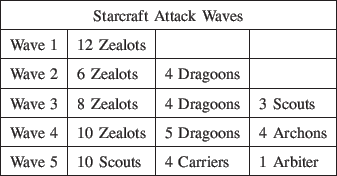
described by the following table.
While this may provide a challenging opponent a handful of times,
competent players quickly learn dominating counter strategies that
allow them to easily defeat computer opponents virtually 100% of the
time. This is boring.
Developers use these kinds of systems because they are a low risk way
to provide specific experiences to players. Developers can be
confident that at time T in the game their AI will perform action A,
leading player into situation B at which point players can overcome
seemingly insurmountable odds by making decision C. While this works
fine for long scripted campaigns, in shorter skirmish matches it
quickly becomes an exercise in seeing the AI do the same actions time
and time again. These systems have a significant cost in expert
knowledge as well, requiring extensive tuning and testing to produce
even moderately challenging players. Even the best scripted systems
are inherently predictable and fragile, with human players quickly
learning dominant counter strategies. To counter this, virtually all
commercial RTS AI systems cheat to provide a more interesting
experience for competent human players - providing the AI with a
complete map of the world as well as additional resources. While more
modern AIs have made strides to overcome these criticisms, generally
by employing subtler cheats, RTS AI systems have yet to approach the
realm of human-level competence without cheating.
As a testbed for this kind of research we next describe LagoonCraft, a
purpose built RTS designed for serious intelligence research, not
entertainment.
LagoonCraft
One of us, Chris Miles, developed LagoonCraft, a real-time 3D naval
combat strategy game, as a platform for this research. While there
are many excellent RTS games, they are developed for entertainment and
are not an optimal environment for research. LagoonCraft has
game-play similar to other RTS games: players gather resources,
construct buildings, create units, and then maneuver those units to
conquer the world. LagoonCraft has two types of resources: oil,
produced by capturing and holding resource points; and power,
generated by constructing power generators. The two fundamentally
different modes of generating resources requires players to compromise
between fighting to expand and control as many points as possible to
maximize oil income while reinvesting as much as possible into power
generators to maximize power income. Figure 7 shows
a screen-shot from LagoonCraft where the blue player is attacking from
the top right, pushing a heavy destroyer through red's lines and
flanking around the left side of the screen. The red player struggles
to maintain a defensive line, pulling back larger ships to engage the
destroyer while smaller boats engage blue's second attack wave.
Figure 8:
LagoonCraft Unit Dominance Graph
|
LagoonCraft has a variety of units organized into three tiers: tier
one units are squads of small boats armed with light weapons, tier two
units are medium sized frigates, and tier three contains heavy
destroyers and cruisers. Units have a complex paper-rock-scissors
dominance graph among them, shown in Figure 8.
Unit to unit dominance is primarily enforced by weapon and armor
characteristics: the missiles fired by a hellfire frigate have
significantly more penetration then the heavy machine guns on an
assault frigate, making them more effective against larger units,
however the missiles are not accurate enough to effectively engage
smaller boats, leading to paper-rock-scissors subgraphs like the one
between the two frigates and the RPG boat in
Figure 8.
Players must carefully choose which types they construct, trying to
bring the mix of units that best counters their opponent's forces.
Higher tier units provide more firepower for their cost in oil, but
are more expensive in terms of power. This allows players to choose
divergent economic strategies: concentrating on capturing oil points
to produce lots of lower tier units, or reinvesting in power
generators to produce higher tier units.
LagoonCraft has a selection of buildings that players can construct shown in Figure 9.
Figure 9:
Buildings in Lagoon
|
Players start the game with a headquarters that constructs scouts and
generates a modest oil income. More headquarters can be built, and
while prohibitively expensive, you lose if all of your headquarters
are destroyed. Resources are generated by oil platforms, which are
captured but cannot be constructed, and power generators which are
built normally. There are three factory buildings that construct
units: a dock which constructs tier one units, a harbor which
constructs tier two units, and a shipyard which constructs tier three
units. The higher tier factories are bigger, more expensive, and more
difficult to destroy.
Figure 10:
Squads of Boats in LagoonCraft Moving In Formation
|
Instead of having players control every action of every one of their
units and buildings, LagoonCraft, like all RTS games, uses a
hierarchical AI system to distribute the work. At the highest level,
players (human or CI) directly make broad decisions which are passed
down to the lower level AI's. The middle level AI system deals with
timing and coordination, breaking long term tasks into smaller ones
that can be handled by the unit AI. At the lowest level, the unit AI
controls individual units to achieve short term tasks via immediate
actions like maneuvering to avoid objects, staying in formation, and
maintaining proper firing positions. Since there is no computational
intelligence involved in the middle and unit AI levels we do not
discuss them futher in this paper.
LagoonCraft is a substantial project, with around 300,000 lines of c++
code and nearly 50,000 lines of python code. Once developed it has
provided an excellent testbed for research in developing RTS
players. More information on LagoonCraft can be found at
http://lagoon.cse.unr.edu. It has been used for a variety of other
projects, both at UNR and within the greater community.
The LagoonCraft research testbed allowed the investigation of a new
approach to play RTS games. This new approach is detailed in the next
chapter.
Developing an RTS Game-Player
We seek to design an AI that can make RTS game-playing decisions.
Playing LagoonCraft requires algorithms that can make the variety of
game-playing decisions presented by the game, including spatial
reasoning, resource allocation and opponent modeling. The goals for
the IMAI are to develop a player that plays complex and robust
strategies while containing those strategies within a representation
amiable to evolution. The IMAI works on the abstract level by casting
the play of the game as a resource allocation problem. IMAI players
run in the continuous loop shown in Figure 11.
Figure 11:
IMAI Main Loop
|
Each iteration has three major phases: resource identification,
objective creation, and resource allocation. In the resource
identification phase, our system analyzes the current game-state
determining which resources (money, buildings, units) are available
for the player to allocate. In the objective creation phase the IMAI
outlines objectives to achieve. Spatial objectives are first created
through a spatial reasoning system as described in
Subsection VI-B. The IMAI then creates
non-spatial objectives including creating units, constructing
buildings, and determining the importance of gathering resources. The
relationships between objectives form a directed graph which
propagates benefit from objectives to their prerequisites as described
in Subsection VI-D.
This produces a set of objectives with associated benefits. The IMAI
then uses an allocation system to search for good allocations that
maximize the benefit realizable with currently available resources as
described in Subsection VI-E. Finally, the
IMAI converts this allocation into the actual commands used to play
the game.
Identifying Resources
We define a resource as something players utilize to achieve
objectives. The IMAI currently identifies the following types of
resources:
- Basic Resources: Oil, Power
- Builders: Capable of constructing units
- Units: Capable of moving, fighting and capturing
- Build Points: Places buildings can be constructed
Identifying resources requires the AI to parse the game-state and
determine the relevant information. Most of this information is
readily provided by the game. The final and most complicated category
of resources, build points are unique in that they represent locations
on the map to construct buildings, something that requires a spatial
reasoning decision to determine. To identify these locations We use a
simplification of the spatial reasoning system used to create
objectives. We develop this general spatial reasoning system in the
next section.
Spatial Reasoning
The spatial reasoning system analyzes the game-state in order to
produce a set of spatial objectives for the IMAI to carry out, see
Figure 12. Since spatial reasoning
decisions form much of the core RTS game-play, the IMAI represents its
spatial reasoning strategies in a way amenable to evolution. While
spatial reasoning is an area of significant research in computer
science and powerful techniques such as qualitative constraint
calculi [39] exist, We develop a novel spatial reasoning
system - IMTrees - to represent spatial reasoning decisions in an
evolvable way.
Figure 12:
Spatial Reasoning Pipeline
|
An enormous variety of spatial reasoning strategies exist in RTS games
- even among seemingly simple decisions like where to place basic
buildings complex strategies emerge. For example, Starcraft players
can use basic supply depots to funnel enemy melee units into well
defended kill zones. Representing these strategies in a generic and
expressive way while maintaining enough focus to be evolvable is one
of the cornerstone problems tackled in this work. Inspired by a wide
variety of sources, We use a tree structured representation forming
simple building blocks into a larger structure to contain complex
ideas within a simple representation. Specifically, we use Influence Maps (IMs) as
a basic spatial reasoning block to contain a simple spatial concept
such as "away from enemy factories". By forming these blocks into an
Influence Map Tree or IMTree We develop a representation capable of
containing complex spatial reasoning strategies. IMTrees have
similarities to Genetic Programming, an outgrowth of genetic
algorithms that evolves tree structured programming elements to solve
a variety of problems [40]. While IMTree based spatial
reasoning has significant differences, the successes and failures of
genetic programming highlight many of the strengths and weakness
involved in evolving tree structured representations. In the next two
sections We describe influence maps and influence map trees, the
foundations of my spatial reasoning system.
An influence map (IM) is a grid placed over the world, with values assigned to each square by some function (IMFunction).
Once calculated, each influence map relates some spatial feature or concept determined by the IMFunction.
Influence maps evolved out of work done on spatial reasoning within the game of Go and have been used sporadically since then in various video games [11].
Figure 13 is a visualization of an influence map, with the IMFunction being the number of triangles within some radius.
If each triangle was a resource location, and the radius of the circle was the effective resource gathering distance, this IM could be used to find optimal resource gathering locations for any situation.
Figure 13:
Influence Map Displayed as Numbers
|
Influence maps in video games developed to meet the needs of turn based war-games, predecessors of real-time Strategy games, that placed a high priority on competent AI.
Influence maps are still used in a variety of games, especially within the RTS genre.
For example, Age of Empires [10] uses influence maps to determine building locations (as part of its attack in waves system) using an IMFunction based on nearby related resources.
For example, to construct a granary, which stores food, an IM summing up the number of food producing entities within the effective radius of that building is created.
By finding locations in the IM with high values, the AI can determine good locations to place its buildings.
Figure 14:
Influence Maps for Go, see GoBlob [41]
|
Influence maps can be rendered in a graphical format that humans can read fairly easily - Figure 14 is displaying various characteristics of a Go board [41].
Because of their readability influence maps can be developed, tested and debugged in ways not possible with other spatial reasoning approaches such as neural networks.
IMs have traditionally been hand-coded to solve particular problems, with a set of IMs combined through a weighted sum to produce solutions to more complicated problems.
In contrast, We use a tree structure to allow for a more expressive and general representation.
Influence Map Specifics
We use one fundamental type of influence map, the ``near" IM, which has values based on the vicinity or distance from a type of unit or building.
To completely define an IM we need to specify a number of parameters and coefficients, listed below:
- Relevant side encoded as a two bit binary integer, is one of the following:
- Friendly units
- Enemy units
- Neutral units
- Any side
- Relevant Entity Category encoded as a two bit binary integer, is one of the following
- Units
- Buildings
- Resource points
- Effective Radius encoded as a two bit binary integer, is one of the following:
 meters
- Effective weapon range of relevant units
 meters
  Unit Size
- How values are distributed within the circle encoded as a two bit binary integer specifying one of the following types of distributions:
- Highest values near the unit, linearly fall off towards zero at the radius
- Highest value along the circumference, linearly falling off towards the unit
- Consistent values throughout the circle
- Effect only the single closest square
- What values to assign encoded as a two bit binary integer specifying one of the following values or sources:
- One
- Value of relevant entities
- Power of relevant entities, where power is an abstract value assigned to the entity denoting tier
-
 of relevant entities
- Radius Coefficient which is multiplied by the effective radius and ranges between
 and
and
- Value Coefficient which is multiplied by the value within each square of the IM, and ranges between
 and
and
For example, in Figure 15 there is a single friendly headquarters, which is adding value to the squares surrounding it based on the value of the headquarters.
Values linearly fall off as you move away from the headquarters up to a maximum radius of meters multiplied by a radius coefficient of approximately 1.3.
Figure 15:
Near Friendly Buildings
|
Influence Map Trees
We contain IMs within a tree structure instead of the traditional weighted list [11] to allow increased complexity while retaining the same basic components.
Each tree represents a complete decision making strategy in a form that can be encoded and evolved by a genetic algorithm.
Figure 16:
Influence Map Tree
|
Leaf nodes in the tree are regular IMs, using an IMFunction to generate their values based on the game-state.
Branch nodes perform operations on their children's values in order to create their own values.
These operations include simple arithmetic operators to form new values, such as combining their children's values in a weighted sum or multiplication to form new values.
These nodes also perform processing on their children, smoothing or normalizing their values.
Many game AI developers use specialized post-processing to manipulate and customize their influence maps.
For example, Age of Empires [10], uses multi-pass smoothing on influence maps to determine locations on which to construct buildings.
By allowing nodes in my tree to perform such processing, a single IMTree can concisely represent a large variety of spatial reasoning strategies.
An example of an IMTree is shown in Figure 16.
This IMTree is an evolved strategy determining where the player should place buildings.
The first leaf IM is a "near friendly buildings" node, shown in Figure 15, which tells the player to build buildings in the general area of existing ones.
The second leaf IM is a "negative values near friendly buildings" node, shown in Figure 17, which tells the player not to build too close to existing buildings.
The second IM differs from the first in that its radius coefficient is smaller, and its value coefficient is negative, leading it to have high negative values within a smaller radius.
These two nodes are children of a summation branch node, which sums them up to produce the IM shown in Figure 18.
Figure 17:
Negative Values near Friendly Buildings
|
Figure 18:
Near Friendly Buildings + Away Friendly Buildings
|
This IM is then multiplied by two further IMs to produce a resulting IM that represents the complete IMTree.
The first multiplier is a game determined limitation on how far away players can construct their buildings, shown in Figure 19.
The building limiter restricts players to build things near other buildings, and not on top of land.
The second multiplier is an ``away enemy buildings" node, which generally biases the player to build as far from enemies as possible, shown in Figure 20.
Figure 19:
Game Limitation on Building Locations
|
Figure 20:
Away Enemy Buildings
|
Figure 21:
Final Building Placement IM
|
Figure 22:
Final Building Placement IM in A More Complex Situation
|
The final result is the IM shown in Figure 21.
This IMTree leads the player to construct buildings in a rough hexagon grid, which is an efficient pattern.
Note that this IMTree encodes a spatial reasoning strategy that can be applied to any situation, later in the game when more buildings have been constructed the IMTree produces a resultant IM that looks like Figure 22.
The IMAI possesses the following IMTrees, each of which has a specific purpose:
- attack details places to send units to attack
- defend details places to send units to defend
- stage details places to send units to move
- civilian construction details where to construct power generators
- military construction details where to produce factories
Each of these IMTrees reduces to a single influence map, with high
values near promising locations to carry out the IMTree task. The
IMAI then uses a local maxima finding algorithm to convert this IM
into a set of objectives that resources can be allocated to. The
algorithm works by iteratively creating objectives at the highest
point in the influence map that is not within some distance of
other objectives. These objectives receive a raw benefit score
based on the value of the IM at that point, this raw benefit
scores is used by the allocation system described in
Section .
The IMAI uses three basic types of branch nodes, an operator node
which performs mathematical operators on multiple children, a
gaussian node, that applies a gaussian blur function to a single
child, and a normalization node that normalizes a single child.
The operator nodes expose a single parameter to the encoding,
describing which operation it performs on their children. The
operation can be either:
- Addition, value for a square is the summed values for that square in all children
- Subtraction, the first IM is added with negated versions of other children
- Multiplication, child values are multiplied together
- Division, the first child value is divided by the other children
- Maximization, the highest value out of all child is taken for a square
- Minimization, the lowest value out of all children is taken for a square
Normalization nodes always normalize between 0 and 1, and gaussian nodes expose a single coefficient describing the radius of the gaussian blur.
Figure 23:
My Objectives in Supreme Commander
|
An objective is a task which the player considers beneficial to accomplish.
The IMTree system first creates spatial objectives to determine where to attack, defend, and expand.
The IMAI then creates construction and training objectives for each type of building and unit.
Finally, the IMAI creates resource gathering objectives which determine the value of the various resource types to the player.
Having described the spatial reasoning system, the following sections detail objective chaining and resource gathering.
Objective Chaining
Figure 24:
Objective Chaining
|
Many objectives do not have self determined benefit, instead being beneficial with respect to reaching other objectives.
For example, the benefit associated with capturing points depends on both the spatial location of the point which determines how quickly can it be captured and how easily can it be defended, as well as the overall situation of the player's economy, which determines how badly the player needs the resources that point produces.
Objective chaining works by forming the various objectives into a directed graph with associated objectives passing benefit to each other via objective links.
The IMAI uses three types of links: additive, multiplicative and hypothetical.
Spatial objectives are chained to unit creation objectives through hypothetical links - by performing a hypothetical allocation with an addition unit of the type the objective creates, we can take the gain in benefit as the benefit to associate with the unit creation objective.
For example, if having a scout allowed me to get 15 additional benefit, We would associate 15 benefit with training more scouts.
Unit creation objectives are chained to building construction objectives by simple additive links - if a cruiser is worth 45 points to me and a destroyer is worth 65, then a shipyard, which produces cruisers and destroyers, is worth 110 (unless We already have a shipyard, in which case this is reduced depending on how much the current shipyard is being used).
Resource gathering objectives have additive links to create power generator objectives, and multiplicative links to capture points objectives, which come with a normalized fitness from the spatial system relating to how defensible of a location they are in.
In Figure 24 the acquire oil objective is passing benefit to the capture point objectives, which in turn passes benefit to the create scout objective, as that is the best unit to capture points.
This benefit finally chains on to the create docks objective, leading the player to assign benefit to creating docks proportional to its need for resources - which is very high at the beginning of the game because income is very small.
The objective chaining system propagates benefit from objectives to their prerequisites with the result being a collection of objectives, from places on the map to attack and defend, to construction and unit creation orders.
Each objective has an associated benefit, determined both from its own merit and its relationship to other objectives.
Allocation
Once resources have been identified and objectives have been created, the IMAI searches to finds a good allocation of resources to objectives.
The purpose of allocation is to find the resource to objective allocation that maximizes expected benefit.
To determine this expected benefit, We create resource-objective benefit functions which estimate the benefit the player will receive by allocating some set of resources to an objective.
Most objective types have raw benefit scores associated with them as they are created, this benefit being partially realized by the set of resources allocated to that objective.
Benefit functions return benefit for unfeasible allocations: allocations which cannot achieve the objective still have some estimated benefit - allocating 2/3 of the money required to construct a building returns 2/3 of the raw benefit associated with constructing that building.
Allowing benefit for unfeasible allocations provides a simpler landscape for the allocation search algorithm.
To make sure that final allocations are feasible We also develop feasibility functions, which final allocations are required to pass.
We develop three core benefit functions, for the three categories of objectives: spatial, building construction and unit creation, and resource gathering.
The IMTree system assigns a raw benefit to spatial objectives as they are created, which is realized by allocating units, allocating a group of units close to the goal and powerful enough to overcome potential resistance returns maximal benefit, while allocating a smaller group of poorly matched units that are farther away returns less benefit.
To determine how well matched units are We develop a combat estimation function which estimates the ratio of strengths between two group of units as described in Section .
Spatial objectives are feasible if at least one unit has been allocated and the ratio of strengths between friendly and enemy units surpasses a certain threshold.
We encode and evolve this parameter to allow the search to coordinate risk-aversion with the player's overall strategy.
Construction and training objectives receive their benefit from the objective chaining system, which propagates it from associated spatial objectives - an attack objectives adding benefit to objectives that train offensive units.
For buildings, this benefit is adjusted by a metric of long term usage calculated based on total usage over the last few minutes of each category of building, additional docks are only constructed if existing ones are running at capacity.
Construction and training objectives are feasible if enough basic resources have been allocated to purchase the unit and if a builder or build-point has been allocated.
Resource gathering objectives have benefit proportional to
 .
.
 and
and  are basic real valued coefficients describing the players spending behavior that are encoded and evolved.
The IMAI assigns less priority to stockpiling a resource as the stock or income of that resource grows, leading that resource to be more freely spent.
The IMAI does not directly assign resources to achieve resource gathering objectives, using them instead as proxies in the objective chaining system to pass benefit onto the objectives that produce resources: capturing points and building power generators - Section .
The benefit associated with resource gathering objectives is also applied as a cost to allocations of such basic resources, the expected benefit resulting from allocating 1000 resources to Task A is reduced by the value of those 1000 resources.
This gives the IMAI a tendency to maintain a reserve of basic resources until high benefit objectives become available (attacking an enemy weakness, or defending against incoming attacks).
are basic real valued coefficients describing the players spending behavior that are encoded and evolved.
The IMAI assigns less priority to stockpiling a resource as the stock or income of that resource grows, leading that resource to be more freely spent.
The IMAI does not directly assign resources to achieve resource gathering objectives, using them instead as proxies in the objective chaining system to pass benefit onto the objectives that produce resources: capturing points and building power generators - Section .
The benefit associated with resource gathering objectives is also applied as a cost to allocations of such basic resources, the expected benefit resulting from allocating 1000 resources to Task A is reduced by the value of those 1000 resources.
This gives the IMAI a tendency to maintain a reserve of basic resources until high benefit objectives become available (attacking an enemy weakness, or defending against incoming attacks).
To perform the actual allocation We have developed two techniques: a genetic algorithm, and a greedy search algorithm.
We first developed a genetic algorithm (AllocGA) to do the resource to objective allocation.
AllocGA came from work We did for my masters thesis that used genetic algorithms to do strike force asset allocation within a real-time strategy game [42,43,44,45,46].
Section provides an overview of genetic algorithms.
AllocGA is a GA which uses single point crossover, bitwise mutation and roulette wheel selection.
AllocGA used a simple enumeration encoding for the allocation, with each resource receiving a set of bits to encode an integer identifying which resource it was allocated to.
It encodes potential allocations between resources and objectives as individuals in its population.
The fitness for each individual is a summation of the benefits expected from each element in its allocation.
AllocGA was highly effective at finding good allocations, particularity in light of the complexity of some of the allocations.
However, AllocGA suffered from two fundamental issues: it was computationally expensive to run a GA while the game was running, and when rerun it would produce allocations that were similar in overall benefit but different in implementation.
The second issue led to a critical case of indecisiveness as it would frequently redirect boats to other goals, to the point where nothing was accomplished.
For example, the player has two scouts and two points it wants to capture on opposite sides of the map.
The first run through AllocGA sends scout 1 to point A, and scout 2 to point B.
Thirty seconds later when run again, it redirects scout 1 to point B, and scout 2 to point A.
It repeats this process indefinitely, with neither point ever being captured because the scouts are constantly turning around.
To solve this problem We developed a greedy algorithm to perform the allocation.
The greedy algorithm works by scanning all possible resource and objective pairs and taking the one which provides the most benefit.
It then repeats on the remaining resources and objectives so long as its continues to increase the sum benefit of the complete allocation.
The greedy allocator was significantly faster and more repeatable then the GA, but was not as good at finding good allocations in the face of more complicated situations, such as when it takes a particular mix of units to effectively assault an enemy fortification.
Combat Estimation
We develop a combat estimation system that the IMAI uses to estimate the benefit it will receive from sending its forces to engage enemy units.
This is an non-trivial and important task for RTS game players to do which requires significant experience for humans to learn.
This is also an area where commercial RTS AI is traditionally weak, forming one of the most effective ways for humans to manipulate artificial opponents.
To do this correctly We need a function that properly estimates the outcome of combat between any two collections of units.
We first outline several desired properties for this function:
- More
 Less, 5 Riflemen should defeat 4 Riflemen
- Environment - Skirmishers in broken terrain defeat Cavalry but Cavalry in open terrain defeat Skirmishers.
- Mixed Forces - 5 Riflemen, 3 Anti Tank Guns, 3 Tanks are better then 8 Riflemen, 6 Tanks
- Heavy weapons - 1 tank defeats 100 riflemen, i.e. some units cannot by defeated purely through numbers
- Economies of scale - 1 zealot defeats 4 marines, but 40 marines defeat 10 zealots
- Group Dynamics - Unit types C and D are weak individually, but powerful when used together
This is a complex problem - units have a wide variety of abilities and skills that cannot be distilled to a single number.
Units have many interactions both with supporting units, enemy abilities, and the nature of the terrain itself.
Because of this a perfect estimation of effectiveness would be extremely difficult to abstract out of most RTS games.
Most commercial RTS AI reduces each unit to a single strength value, incorporates some basic bonuses / penalties based on paper-rock-scissors dynamics, and then compares the summed strengths of both groups of units.
The systems successfully achieve the first two properties, but leave significant room for improvement with the last four issues.
We developed a novel combat estimation technique inspired by game-theory.
We define the output of the function as a single floating point value between 0 and 1 relating the ratio of strengths between the two groups.
A score of 1 means that my forces should completely destroy the enemy with virtually no casualties, while a score of 0 is total defeat, and a .5 is an even fight.
We ignore the concepts of terrain and economies of scale, as neither of those are fundamentally important in LagoonCraft.
We create a unit-effectiveness matrix describing how quickly a unit can kill any other opposing unit under ideal conditions, an example of which is shown in Figure 25.
Figure 25:
Example Unit Effectiveness Matrix
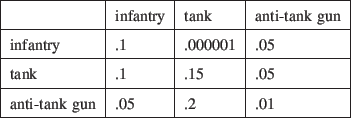 |
In my example matrix, for example, the infantry unit can destroy .1 other infantry units within some arbitrary time unit.
So in 10 time units a squad of infantry can completely destroy an enemy squad of infantry, while taking virtually forever to destroy an enemy tank.
Figure 26:
Unit Mixed Strategies
|
For each unit on both sides We calculate a mixed strategy for how they will distribute their offensive capabilities.
We assume that units can perfectly distribute their fire in whichever way they want.
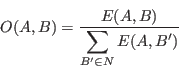
Units distribute their offensive capabilities against the set of enemy units proportional to their unit effectiveness against that unit divided by their sum effectiveness against all enemy units, as in Equation 2.
 |
(2) |
Were an  are units from sides
  and
and  respectively.
 is the percentage of 's attacks that are going to
  and
and  is the unit effectiveness score describing how much damage can do to .
In Figure 26 for example, the riflemen on the left are distributing their fire evenly against the riflemen on the right, because they have very little effectiveness against the tank.
The tank on the right is effective against most unit types, so it is distributing its fire fairly evenly.
The anti-tank guns on the left are primarily useful against enemy armor, so they are concentrating on the enemy tanks.
is the unit effectiveness score describing how much damage can do to .
In Figure 26 for example, the riflemen on the left are distributing their fire evenly against the riflemen on the right, because they have very little effectiveness against the tank.
The tank on the right is effective against most unit types, so it is distributing its fire fairly evenly.
The anti-tank guns on the left are primarily useful against enemy armor, so they are concentrating on the enemy tanks.
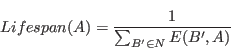
Once the mixed strategies for each unit have been calculated, we can determine total lifespan for each unit, per Equation 3.
 |
(3) |
For our example this produces the lifespans shown in Figure 27.
Figure 27:
Unit Lifespans
|
We then calculate the ratio of strength between the two forces as:
 |
(4) |
The longest surviving unit on the left is the Tank, which survives 1.85 time units, compared to the tanks on the right which survive 1.38 time units.
This gives a strength ratio of
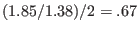 .
Our estimation system is giving the left group of units a moderate advantage.
While the actual outcome of the fight would depend upon many factors, my estimation system does a significantly better job of dealing with the important dynamics of the problem that the ``sum and compare" systems present in most RTS games.
Expanding my force composition system to deal with terrain could be done by having various unit-effectiveness matrix's for each type of terrain.
Dealing with economies of scale and group dynamics would be very interesting avenues for future research.
.
Our estimation system is giving the left group of units a moderate advantage.
While the actual outcome of the fight would depend upon many factors, my estimation system does a significantly better job of dealing with the important dynamics of the problem that the ``sum and compare" systems present in most RTS games.
Expanding my force composition system to deal with terrain could be done by having various unit-effectiveness matrix's for each type of terrain.
Dealing with economies of scale and group dynamics would be very interesting avenues for future research.
These systems combine together to form the IMAI, which can represent and play robust RTS strategies.
Instead of hand-tuning these strategies, which is time-consuming and error-prone, We use automated search techniques to generate them.
Specifically, We use a co-evolutionary genetic algorithm, as described in the next chapter.
With the IMAI providing a representation of game-playing strategies, I
can investigate methods for generating effective strategies. We develop
a Co-evolutionary Queue based Genetic Algorithm (CoQuGa) to perform
this search. Searching to find good strategies instead of hand-coding
them reduces the cost in expert knowledge and allows for the
development of more complex players. RTS games are designed to have a
non-linear search space of complex strategies, making it difficult to
apply many traditional search techniques. We use genetic algorithms
because they have been historically effective at solving difficult
search problems [36].
CoQuGa maintains a population of individuals, each of which in turn
encodes a strategy for the IMAI to use. We evaluate these Individuals
within CoQuGa by playing them against other members of the population,
making CoQuGa a co-evolutionary system. CoQuGa is a steady state GA -
frequently creating and destroying a handful of individuals instead of
occasionally replacing the entire population. Evaluating individuals
requires running the game, which is computationally expensive. To
overcome this we use a master-slave distributed model that distributes
evaluations over a network of computers, shown in Figure 6.1. Within
the master-slave model, the master maintains the population and
applies genetic operators while the slaves perform the
This demo file is intended to serve as a ``starter file''
for IEEE journal papers produced under LATEX using
IEEEtran.cls version 1.7 and later.
Wish you the best of success.
mds
January 11, 2007
Subsection text here.
Subsubsection text here.
The conclusion goes here.
Appendix one text goes here.
Appendix two text goes here.
The authors would like to thank...
- url@samestyle
- 1
-
=2plus
4 4 solutions for complex tasks,'' in Proceedings of the 5th International
Conference on Genetic Algorithms (GA-93), 1993, pp. 264-270. [Online].
Available: citeseer.ist.psu.edu/angeline93competitive.html=0pt
- 2
-
D. B. Fogel, Blondie24: Playing at the Edge of AI.Morgan Kauffman, 2001.
- 3
-
A. L. Samuel, ``Some studies in machine learning using the game of checkers,''
IBM Journal of Research and Development, vol. 3, pp. 210-229, 1959.
- 4
-
J. B. Pollack, A. D. Blair, and M. Land, ``Coevolution of a backgammon
player,'' in Artificial Life V: Proc.the Fifth Int. Workshop on the Synthesis and Simulation of Living Systems, C. G.
Langton and K. Shimohara, Eds.
Cambridge, MA: The MIT Press, 1997, pp. 92-98.
- 5
-
G. Tesauro, ``Temporal difference learning and td-gammon,''
Communications of the ACM, vol. 38, no. 3, 1995.
- 6
-
=2plus
4 4 www.blizzard.com/starcraft=0pt
- 7
-
R. E. Inc., ``Dawn of war,'' 2005, http://www.dawnofwargame.com.
- 8
-
G. P. Games, ``Supreme commander, http://www.supremecommander.com,'' 2007.
- 9
-
R. E. Inc., ``Company of heroes,'' 2006, http://www.companyofheroesgame.com/.
- 10
-
=2plus
4 4 Available: www.ageofempires3.com=0pt
- 11
-
A. L. Zobrist, ``A model of visual organization for the game of go,'' in
AFIPS Conf. Proc., 1969, pp. 34, 103-112.
- 12
-
C. Miles and S. J. Louis, ``Co-evolving real-time strategy game playing
influence map trees with genetic algorithms,'' in Proceedings of the
International Congress on Evolutionary Computation, Portland, Oregon.IEEE Press, 2006.
- 13
-
---, ``Towards the co-evolution of influence map tree based strategy game
players,'' in Proceedings of the 2006 IEEE Symposium on Computational
Intelligence in Games.IEEE Press,
2006, pp. 75-82.
- 14
-
---, ``Co-evolving influence map tree based strategy game players,'' in
Proceedings of the 2007 IEEE Symposium on Computational Intelligence in
Games.IEEE Press, 2007, p. Pages: to
appear.
- 15
-
=2plus
4 4 www.blizzard.com/war2bne=0pt
- 16
-
A. Barzel, ``The perplexing conclusion: The essential difference between
natural and artificial intelligence is human beings' ability to deceive,''
Journal of Applied Philosophy 15 (2), pp. 165-178, 1998.
- 17
-
B. L. and W. L., ``Evolving adaptive play for simplified poker,'' in
Proceedings of the IEEE International Conference on Computational
Intelligence.IEEE press, 1998, pp.
108-113.
- 18
-
---, ``An adaptive learning model for simplified poker using evolutionary
algorithms,'' in Proceedings of the IEEE Congress of Evolutionary
Computation.IEEE press, 1999, pp.
153-160.
- 19
-
---, ``Adaptive learning for poker,'' in Proceedings of the Genetic
and Evolutionary Computation Conference, 2000, pp. 566-573.
- 20
-
B. D., P. D., S. J., and S. D., ``Poker as a testbed for machine intelligence
research,'' pp. 1-15, 1998.
- 21
-
---, ``Opponent modeling in poker,'' in Proceedings of the 15th
National Conference of the American Association for Artificial Intelligence,
1998, pp. 493-499.
- 22
-
---, ``Using probabilistic knowledge and simulation to play poker,'' in
Proceedings of the 16th National Conference of the American Association
for Artificial Intelligence, 1999, pp. 697-703.
- 23
-
F. N., ``Studies in machine cognition using the game of poker,'' in CACM
20(4), 1977, pp. 230-245.
- 24
-
K. G. and W. M., ``An investigation of an adaptive poker player,'' in
Proceedings of 14th Australian Joint Conference on Artificial
Intelligence.Springer-Verlag, 2001,
pp. 189-200.
- 25
-
S. J., B. D., P. L., and S. D., ``Learning to play strong poker,'' in
Proceedings of the Sixteenth International Conference on Machine
Learning, 1999.
- 26
-
von Neumann J. and M. O, Theory of Games and Economic Behavior.Princeton University Press, 1944.
- 27
-
J. Holland, Adaptation in Natural and Artificial Systems.University of Michigan Press, 1975.
- 28
-
D. Goldberg and J. Richardson, ``Genetic algorithms with sharing for multimodal
function optimization,'' in Proceedings of the 2nd International
Conference Genetic Algorithms.j. J.
Grefensette, Ed. Hillsdale, NJ: Lawrence Erlbaum, 1987, pp. 41-49.
- 29
-
K. A. DeJong, ``An analysis of the behavior of a class of genetic adaptive
systems,'' 1975.
- 30
-
C. D. Rosin and R. K. Belew, ``Methods for competitive co-evolution: Finding
opponents worth beating,'' in Proceedings of the Sixth International
Conference on Genetic Algorithms, L. Eshelman, Ed.San Francisco, CA: Morgan Kaufmann, 1995, pp. 373-380.
- 31
-
=2plus
4 4 Australian Joint Conference on Artificial Intelligence, 2001, pp.
189-200. [Online]. Available:
citeseer.nj.new.com/kendall01investgation.html=0pt
- 32
-
=2plus
4 4 Available: www.cavedog.com/totala=0pt
- 33
-
R. E. Inc., ``Homeworld,'' 1999, homeworld.sierra.com/hw.
- 34
-
J. E. Laird, ``Research in human-level ai using computer games,''
Communications of the ACM, vol. 45, no. 1, pp. 32-35, 2002.
- 35
-
J. E. Laird and M. van Lent, ``The role of ai in computer game genres,'' 2000,
http://ai.eecs.umich.edu/people/laird/papers/book-chapter.htm.
- 36
-
---, ``Human-level ai's killer application: Interactive computer games,''
2000, http://ai.eecs.umich.edu/people/laird/papers/AAAI-00.pdf.
- 37
-
P. S. Rosenbloom, J. E. Laird, and A. Newell, The Soar Papers.The MIT Press, 1993.
- 38
-
M. Buro, ``Orts,'' 2007, http://www.cs.ualberta.ca/ mburo/orts/.
- 39
-
B. N. J. Renz, ``Qualitative spatial reasoning using constraint calculi,''
M. Aiello, I. Pratt-Hartmann, J. van Benhtem (eds).: The Logic of
Space, 2006.
- 40
-
J. Koza, Genetic Programming: On the Programming of Computers by Means of
Natural Selection.MIT Press, 1992.
- 41
-
L. Meckes, ``goblob,'' 2007, http://canutkiin.jeudego.org/go_blob/.
- 42
-
S. J. Louis, C. Miles, N. Cole, and J. McDonnell, ``Learning to play like a
human: Case injected genetic algorithms for strategic computer gaming,'' in
Proceedings of the second Workshop on Military and Security
Applications of Evolutionary Computation, 2005, pp. 6-12.
- 43
-
=2plus
4 4 human: Case injected genetic algorithms for strategic computer gaming,'' in
Proceedings of the International Congress on Evolutionary Computation,
Portland, Oregon.IEEE Press, 2004,
pp. 1441-1448. [Online]. Available:
http://www.cs.unr.edu/~sushil/papers/newpapers/2004/cec/miles/cec2004/paper/paper/=0pt
- 44
-
=2plus
4 4 game playing with case injected genetic algorithms,'' in Proceedings of
the 2004 Genetic and Evolutionary Computing Conference (GECCO 2004), Seattle,
WA, 2004, pp. 1365-1376. [Online]. Available:
http://www.cs.unr.edu/~sushil/papers/newpapers/2004/gecco/sf/gecco2004/414/414/=0pt
- 45
-
S. J. Louis and C. Miles, ``Combining case-based memory with genetic algorithm
search for competent game ai,'' in Proceedings of the 2005 Workshop on
CBR in Games, 2005, pp. 193-205.
- 46
-
S. J. Louis, C. Miles, N. Cole, and J. McDonnell, ``Playing to train:
Case-injected genetic algorithms for strategic computer gaming,'' in
Proceedings of the first Workshop on Military and Security Applications
of Evolutionary Computation, 2004, pp. 6-12.


Co-evolving Real-Time Strategy Game Players
This document was generated using the
LaTeX2HTML translator Version 2008 (1.71)
Copyright © 1993, 1994, 1995, 1996,
Nikos Drakos,
Computer Based Learning Unit, University of Leeds.
Copyright © 1997, 1998, 1999,
Ross Moore,
Mathematics Department, Macquarie University, Sydney.
The command line arguments were:
latex2html -split 1 coevolveRTS
The translation was initiated by Sushil Louis on 2012-10-18
Sushil Louis
2012-10-18