|
We have performed a number
of experiments and comparisons in order to
demonstrate the performance of the proposed gender classification approach.
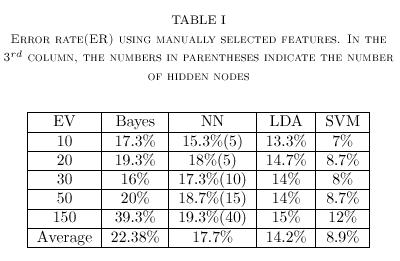
First, each classifier was tested using manually selected eigen-features. We run several experiments
varying the number of eigenvectors from 10 to 150. The averaged performances are summarized in Table 1.
In the next set of our experiments, we used GAs to select optimum
subsets of eigenvectors for gender classification. The GA
parameters we used in all experiments are as follows: population
size: 350, number of generations: 400, crossover rate: 0.66 and
mutation rate: 0.04. It should be noted that in every case, the GA
converged to the final solution much earlier (i.e., after 150
generations). Fig. 2 shows the average error rate obtained in
these runs. The results illustrate clearly that the feature
subsets selected by the GA have reduced the error rate of all the
classifiers significantly.
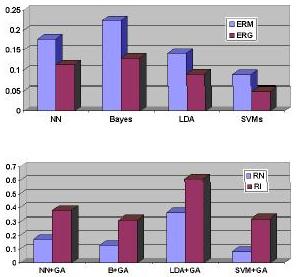
Fig.2. (Top): Error rates of various classifiers using
features subsets selected manually or by GAs. ERM: the error rate
using the manually selected feature subsets; ERG: error rate using
GA selected feature subsets. (Bottom): A comparison between
the automatically selected feature subsets and the complete
feature set. RN: the ratio between the number of features in the
GA-selected feature subsets and the complete feature set; RI: the
percentage of the information contained in the GA-selected feature
subset
|
As we have discussed before, different
eigenvectors seem to encode different kinds of information. For
visualization purposes, we have reconstructed the facial images
using the selected eigenvectors only (Fig. 3). Several
interesting comments can be made through observing the
reconstructed images using feature subsets selected by GAs.
First of all, it is obvious that face
recognition can not be performed based on the reconstructed faces
using only the eigenvectors selected by the GA - they all look
fairly similar to each other. In contrast, the reconstructed faces
using the best eigenvectors (i.e., principal components) do reveal
identity as can be seen from the images in the second row. The
reconstructed images from eigenvectors selected by the GA,
however, do disclose strong gender information - the
reconstructed female faces look more "female" than the
reconstructed male faces. This implies that the GA did select out
eigenvectors that seem to encode gender information. Second, those
eigenvectors encoding features unimportant for gender
classification seem to have been discarded by the GA. This is
obvious from the reconstructed face images corresponding to the
first two males shown in Fig. 3.. Although both of them
wear glasses, the reconstructed faces do not contain glasses which
implies that the eigenvectors encoding glasses have not been
selected by the GA. Note that the reconstructed images using the
first 30 most important eigenvectors (second row) preserve
features irrelevant to gender classification (e.g., glasses).
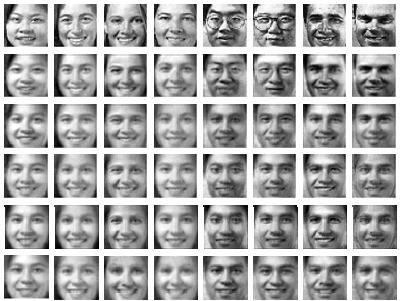
Fig.3.Reconstructed images using the selected feature subsets.
First row: original images; Second row: using top 30 eigenvectors;
Third row: using the eigenvectors selected by Bayes-PCA+GA; Fourth
row: using the eigenvectors selected by NN-PCA+GA; Fifth row:
using the eigenvectors selected by LDA-PCA+GA; Sixth row: using
the eigenvectors selected by SVM-PCA+GA.
|
|