|
|
|
Support vector regression is to construct a function that has small deviation
from actually obtained targets for all the training data, meanwhile, specify
an upper bound on the fraction of training points allowed to lie outside
of a distance from the regression estimation, called as Supposed there are training inputs
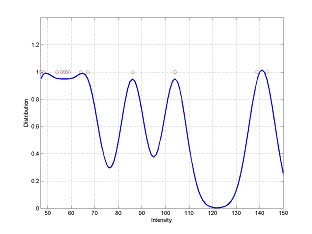
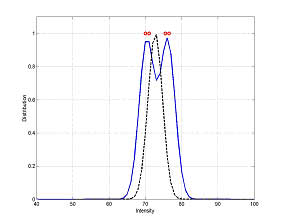
Figure 1 shows different representations for modeling background based on small training data at a fixed spatial position, such as support vector regression, supervised mixture of Gaussian distribution with 2 and 4 clusters, single Gaussian distribution. In Figure 1, training inputs and the estimated intensity distribution were described as red cycles and blue curve, respectively. In Figure 1 (d), a comparison between SVR and single Gaussian distribution labeled as blue curve and dash curve, respectively, has been shown. From Figure 1, it can be seen that support vector regression provide more accurate estimation function to fit the training data than mixture of Gaussian distribution and single Gaussian distribution.
[1] Marti Hearst, "Trends and controversies - support vector machines".
IEEE Intelligent Systems, 13(4): 18-28,1998 [2] Alex J. Smola and Bernhard Scholkopf, "A tutorial on support
vector regression", [3] J. Ma and J. Theiler, "Accurate on-line support vector regression",
Neural Computation, 15,2683-2703,2003. [4] J. W. Davis and V. Sharma, "Robust background-subtraction for
person detection in thermal imagery", IEEE,CVPR,2004 [5] J. W. Davis and M. A. Keck, "A two-stage template approach to person detection in thermal imagery", IEEE,CVPR,2005 |
||||||||||||||||||||||||||||||||||||||||||||||||||||||||||||||||||||||||||||||||||||||||||||||||||||||||||||||||||
|
|





 Background
Modeling Based on Support Vector Regression
Background
Modeling Based on Support Vector Regression -insensitive
support vector regression [2]. In our work, the support vector regression
model exploits the training inputs of intensity values for each pixel
in the background scene to estimate its probability distribution function
as the background model.
-insensitive
support vector regression [2]. In our work, the support vector regression
model exploits the training inputs of intensity values for each pixel
in the background scene to estimate its probability distribution function
as the background model.  ,
where
,
where  are intensity values for each pixel in the background scene,
  are the probability of each pixel being labeled as background (i.e., in
the training data, we manually set the probabilities of those pixels belonging
to the background with high value). For each pixel, the SVR approximation
are the probability of each pixel being labeled as background (i.e., in
the training data, we manually set the probabilities of those pixels belonging
to the background with high value). For each pixel, the SVR approximation
 for the
probability of its intensity belonging to background can be calculated
as follows,
for the
probability of its intensity belonging to background can be calculated
as follows,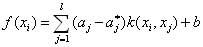
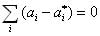
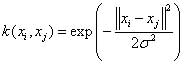
 kernel function and
  are
Lagrange multiplier parameters.
are
Lagrange multiplier parameters.
 and
and