


The problem set is based on the number of one's in a bit string, a variation of
the one-max problem [Ackley, 1987]. We considered problems where a string of
ones was followed by a string of zeros. Consider a string of length
10. Choose a position M in this string. Let  be the number of ones to
the left of M and
be the number of ones to
the left of M and  the number of zeros to the right of M.
The fitness of this string is
the number of zeros to the right of M.
The fitness of this string is

We let M be the index of a problem in this class. The maximum fitness of any of the problems in this class is l, the length of the string. For example, for l = 6, there are 7 problems in this class. This set of problems was chosen for two reasons.
Initially, the system has an empty case-base and the GA starts with a randomly
initialized population. As problems are solved the case-base is built up and
used. We used a chromosome length of 100 and ran the GA with a population
size of 200 for 100 generations, storing the best individual from every
 generation of the GA into the case-base. We did not solve all the
101 problems in the class but restricted the problem set to
generation of the GA into the case-base. We did not solve all the
101 problems in the class but restricted the problem set to  for a total of 51 possible problems. We ran the system ten times with
different random seeds and the results reported are averaged over these ten
runs.
for a total of 51 possible problems. We ran the system ten times with
different random seeds and the results reported are averaged over these ten
runs.
When confronted with a randomly generated problem  from within the class
of about 50 problems the system ranks the problems in the case-base according
to distance from . We use distance proportional selection for
injection where the probability of a problem's solutions being selected for
injection is inversely proportional to distance. In fact, we simply use the
roulette wheel procedure given in Goldberg's book [Goldberg, 1989] and the
probability
from within the class
of about 50 problems the system ranks the problems in the case-base according
to distance from . We use distance proportional selection for
injection where the probability of a problem's solutions being selected for
injection is inversely proportional to distance. In fact, we simply use the
roulette wheel procedure given in Goldberg's book [Goldberg, 1989] and the
probability
 of a problem
  's solutions being selected for
injection is
's solutions being selected for
injection is

where CB denotes the case-base.
When a problem is selected by this procedure we inject one of the stored
solutions to this problem into the initial population of the GA solving
. The solution to be injected is again chosen depending on problem
distance. Recall that we stored the best individual from every
generation. The probability of choosing a solution from a particular generation
is inversely proportional to problem distance.
We used linear scaling with a scaling factor of 1.2 and an elitist selection
scheme in which the offspring compete with the parents for population slots and
where, if N is the population size, the best N individuals from the
combined parent-offspring pool make up the next generation [Eshelman, 1991]. The
probability of crossover was 1.0 and the probability of mutation was set to
0.05. We initialized  of the population with injected cases, the rest of
the population was generated randomly.
of the population with injected cases, the rest of
the population was generated randomly.
Figure 6 plots the number of problems attempted on the horizontal axis versus the generation that the best solution was found. It compares a randomly initialized GA with a CIGAR over ten runs with different random seeds.
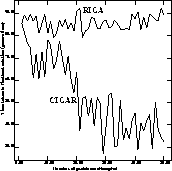
Figure: Number of problems attempted versus time taken to solve a problem
The figure shows that as the number of problems attempted increases the time taken to solve a problem decreases for CIGAR while the randomly initialized GA takes about the same time. After about half of the problems have been attempted there is a statistically significant decrease in the time taken to solve a problem.
We also compare the quality of solutions as the number of problems solved increases for the RIGA and CIGAR in Figure 7 over ten runs with different random seeds.
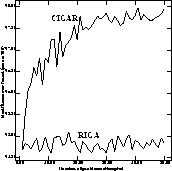
Figure: Number of problems attempted versus best fitness ever found
CIGAR improves its performance as it attempts more problems while the randomly initialized GA's performance stays about the same.